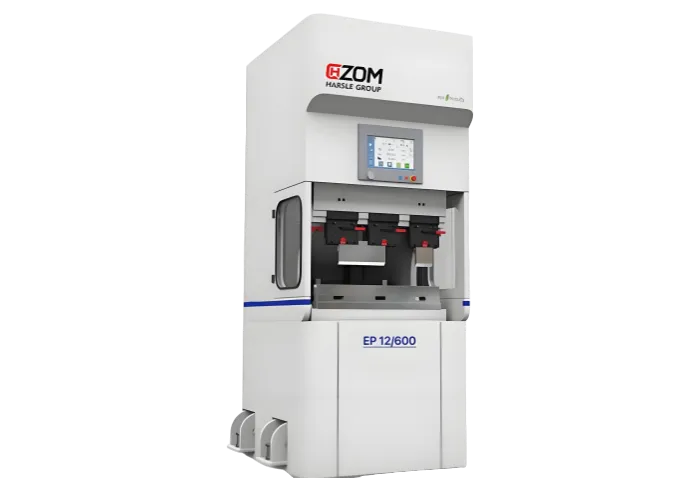
When rolling cylindrical or conical parts, choosing the wrong machine configuration can lead to material waste, additional correction work, and higher production costs. As a core piece of metal forming equipment, plate bending machines are mainly available in two common configurations: 3-roller and 4-roller designs. Each type has its own structural features, performance advantages, and ideal application scenarios.
In this article, we compare these two machine types to help you determine which one is better suited to your production needs.
What Is a Plate Bending Machine?
A plate bending machine, also known as a plate rolling machine, is used to bend metal sheets into cylindrical, arc-shaped, or conical forms through the coordinated movement and pressure of rollers.
Plate bending machines play an essential role in the fabrication of wind tower sections, pressure vessels, oil and gas pipelines, storage tanks, and various structural steel components.
In terms of structural configuration, they are typically categorized into two main types: 3-roller plate bending machines and 4-roller plate bending machines.
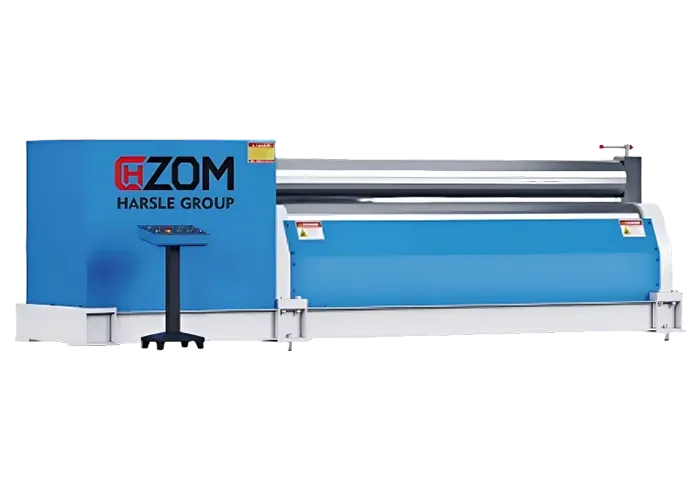
A 3-roller plate bending machine usually consists of one upper roller and two lower rollers. In general, the upper roller moves vertically to apply bending force, while the two lower rollers rotate to drive the plate through the machine.

- Advantages: With its simple structure, the machine offers a lower initial purchase cost and easier maintenance.
- Limitation: Its pre-bending capability is limited, which can leave larger flat ends at both sides of the plate, often requiring edge pressing in advance or additional correction afterward.

A 4-roller plate bending machine adds one more bottom roller compared with the 3-roller design. In this configuration, the plate is clamped firmly between the upper roller and the bottom roller, while the two side rollers move upward to create the bending action.

- Advantages: The machine delivers high-precision pre-bending by firmly clamping the plate edge, allowing extremely short flat ends and ensuring superior forming accuracy.
- Automation-friendly: The plate remains securely clamped throughout the entire process, minimizing slippage and making the machine well-suited for CNC integration and high-volume production.
- One-pass forming: Unlike three-roll machines, it does not require repeated repositioning of the plate, significantly improving production efficiency.
- Limitation: While offering superior precision and automation compatibility, the machine features a more complex design, which leads to a higher initial investment.
Key Differences: 3-Roller vs. 4-Roller Plate Bending Machines
| Comparison Dimension | 3-Roller Plate Bending Machine | 4-Roller Plate Bending Machine |
| Structural Design | Simpler mechanical structure; easier to maintain and more cost-effective. | Advanced design; offers superior plate control and stronger pre-bending performance. |
| Bending Precision | Delivers reliable results, but additional manual adjustments may be needed for top accuracy. | Higher precision; the plate remains securely and continuously clamped throughout rolling. |
| Production Efficiency | Lower efficiency; often requires more manual handling and repeated repositioning. | High efficiency; completes pre-bending and rolling in a single setup without repositioning. |
| Ease of Operation | Requires more operator skill and manual work to guide and adjust the plate. | Easier to operate; ideal for automated or CNC production due to continuous clamping. |
| Initial Investment | Lower upfront cost; a highly practical choice for budget-conscious buyers. | Higher initial investment, but offers better efficiency and accuracy for long-term production. |
1. Structural Design
With its simpler mechanical structure, the 3-roller plate bending machine is generally easier to maintain and more cost-effective. By contrast, the 4-roller plate bending machine features a more advanced design that offers better plate control and stronger pre-bending performance.
2. Bending Precision
Because the plate remains securely clamped throughout the rolling process, the 4-roller plate bending machine typically delivers higher bending precision. The 3-roller model can still produce reliable results, but additional adjustments may be needed to achieve the same level of accuracy.
3. Production Efficiency
In terms of efficiency, the 4-roller plate bending machine has a clear advantage, as it can complete pre-bending and rolling in a single setup without repeated repositioning. The 3-roller machine, on the other hand, often requires more manual handling, which can reduce overall productivity.
4. Ease of Operation
The 4-roller plate bending machine is generally easier to operate, particularly in automated or CNC-controlled production environments, because the plate is continuously clamped and guided during the entire process. In comparison, the 3-roller machine may require more operator skill and manual adjustment.
5. Initial Investment
A 3-roller plate bending machine usually requires a lower initial investment, making it a practical choice for budget-conscious buyers. A 4-roller plate bending machine has a higher upfront cost, but it can provide better efficiency and accuracy for long-term production needs.
Selection Guide
1. Plate Thickness and Width
When handling extra-thick plates, a 3-roller plate bending machine is often the preferred choice thanks to its strong structural stability and better cost-effectiveness.
2. Production Volume
When used in production line environments, a 4-roller plate bending machine usually delivers a stronger return on investment thanks to its higher efficiency and better compatibility with automated production.
3. Accuracy Requirements
In industries with strict quality and tolerance standards, such as pressure vessel manufacturing, the 4-roller plate bending machine is generally the preferred solution because of its superior forming accuracy and more effective pre-bending capability.
4. Budget Constraints
For general fabrication shops where budget control is a priority and flat end requirements are less demanding, a 3-roller plate bending machine can be a more practical and cost-effective choice.
Conclusion

The 3-roller plate bending machine is a versatile and cost-effective option for a wide range of general rolling applications, while the 4-roller rolling machine is better suited to modern manufacturing environments that require higher precision, greater efficiency, and more advanced automation.
To support different manufacturing needs, CHZOM offers a complete range of plate bending solutions, including customized configurations with fully CNC-controlled systems designed to improve productivity and long-term performance.