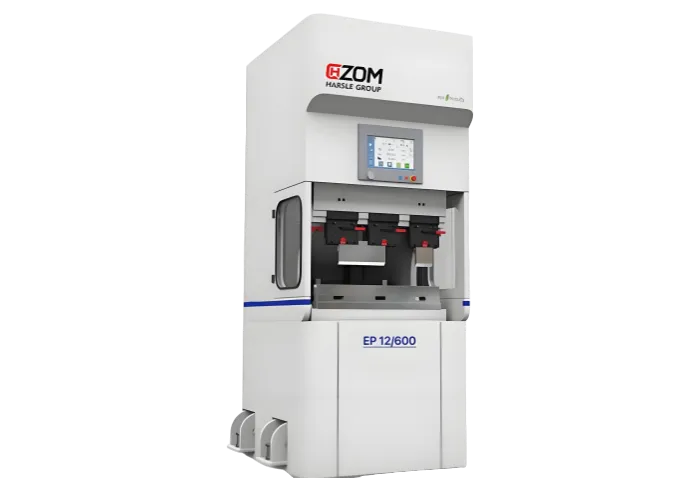
In today’s fiercely competitive manufacturing landscape, sheet metal production—a critical process across numerous industries—frequently faces the challenge of handling small-batch, high-variety orders. Traditional die change processes often consume excessive time, resulting in low equipment utilization and insufficient production flexibility, which directly impacts corporate profitability. Consequently, an “efficiency revolution” centered on SMED (Single Minute Exchange of Die) is quietly gaining momentum. SMED aims to reduce changeover time to the minute level by systematically optimizing transition processes for operations like bending and stamping. As a trusted partner in sheet metal equipment, CHZOM is committed to providing customers with high-efficiency press brakes, laser cutters, hydraulic presses, and punch presses, helping enterprises achieve breakthroughs in rapid tool change. This article will detail the implementation methodology and specific steps of SMED, offering practical guidance for production supervisors, equipment managers, and lean manufacturing practitioners.

The core of SMED lies in categorizing die change operations into internal and external tasks, and converting as many internal tasks as possible into external ones to minimize equipment downtime. Internal operations refer to tasks that must be performed while the machine is stopped, such as mold disassembly and installation. External operations, however, can be prepared in advance while the equipment is running, including mold cleaning, inspection, and transportation. In sheet metal production, press brakes and stamping equipment often require frequent mold changes. CHZOM’s hydraulic presses and punch presses are designed with this in mind, utilizing modular components and standardized interfaces to facilitate external operations. For instance, when using CHZOM press brakes, operators can pre-assemble dies and tools externally, ensuring seamless and efficient die changeovers. This seemingly simple distinction significantly reduces unnecessary downtime, laying the groundwork for subsequent optimization.
Next, converting internal operations into external ones is a critical step in SMED implementation. This requires process reengineering and tool improvements. For example, in stamping operations, die adjustments traditionally necessitated measurement and calibration after machine downtime. However, by pre-setting standardized templates and quick-positioning devices, this work can be shifted to be completed during machine operation. CHZOM’s press equipment features intelligent positioning systems and rapid die-change attachments, enabling operators to pre-adjust dies during production intervals—thus converting internal operations to external ones. Additionally, during the bending process, utilizing CHZOM’s standardized die library and transport carts allows for pre-sorting and inspection of dies off-press. This eliminates last-minute scrambles during die changes. This approach not only shortens changeover times but also reduces the risk of human error, enhancing overall production safety.
Optimizing clamping methods is another crucial aspect of SMED, directly impacting die change speed and stability. In sheet metal production, bending and stamping equipment often relies on traditional bolt clamping, which is time-consuming and labor-intensive. Introducing quick-clamping devices, such as hydraulic or pneumatic clamping systems, can significantly reduce fastening and release times. CHZOM’s bending machines and hydraulic presses extensively incorporate such innovative designs, exemplified by their patented quick-clamping modules. These enable operators to secure dies within seconds without additional tools. Simultaneously, optimizing clamping involves standardizing clamping point locations and force to ensure consistency during every die change. In practical applications, numerous enterprises using CHZOM equipment report that these optimizations have reduced die changeover times from tens of minutes to mere minutes. This has boosted equipment utilization by over 30%, making it particularly well-suited for small-batch, high-variety production models. Such efficiency enables businesses to respond swiftly to market fluctuations.

Beyond the steps outlined above, implementing SMED requires a focus on continuous improvement and employee training. Production supervisors and equipment administrators should regularly analyze changeover data to identify bottlenecks and make fine-tuning adjustments with technical support from CHZOM equipment. The effects of implementing quick changeover are often immediate: reduced equipment downtime, enhanced production flexibility, and the ability to switch between different products in less time, thereby lowering costs and increasing customer satisfaction. In summary, the “efficiency revolution” in sheet metal production is not achieved overnight; it demands a systematic approach and reliable equipment support. As an industry-leading supplier, CHZOM is committed to partnering with you to optimize production through rapid tool change, jointly creating a highly efficient future. If you’re interested in SMED, feel free to contact the CHZOM team for more customized solutions.