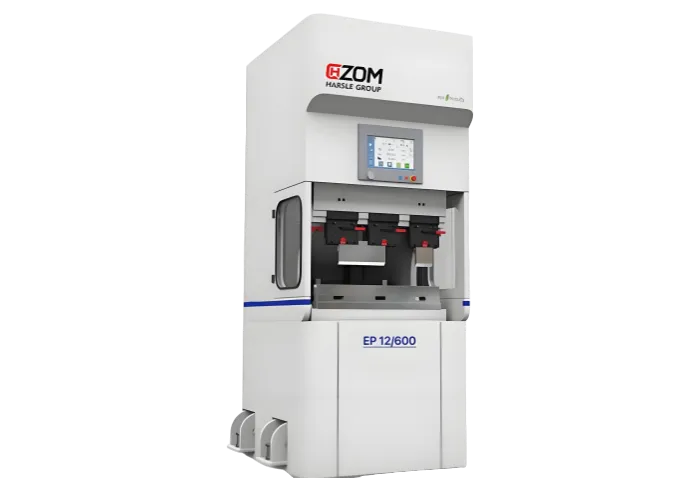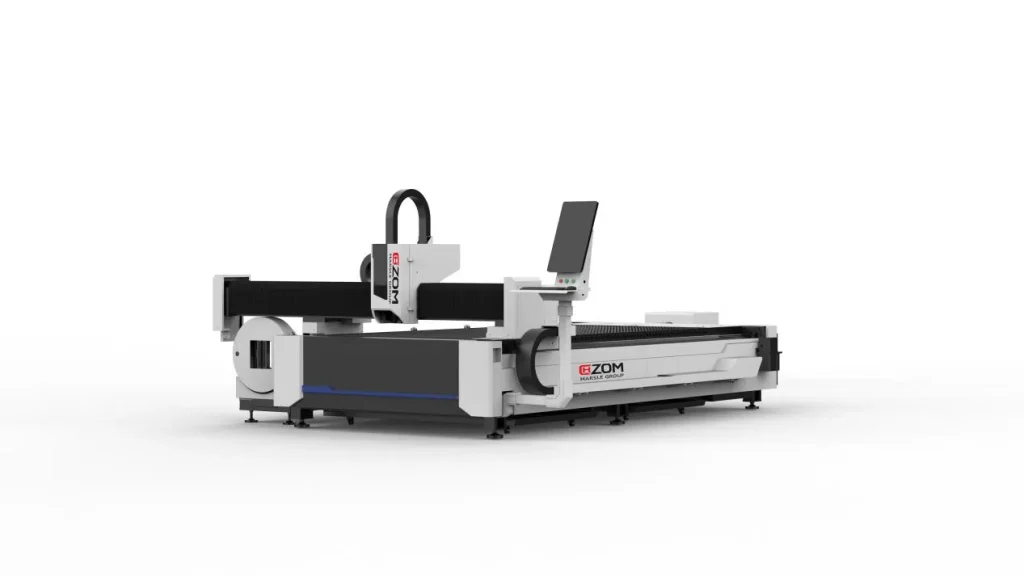
In the sheet metal processing industry, laser cutting machines have become indispensable core equipment. As the “heart” of these machines, the performance of the laser directly determines the cutting capability of the equipment.
As a supplier of sheet metal processing equipment, CHZOM has conducted in-depth research into the core technologies of lasers, aiming to provide customers with the most professional guidance for equipment selection. This article will take you on a journey into the “inner workings” of lasers, analyzing how fiber lasers have become the mainstream choice for modern industrial cutting.
Fiber Lasers: Why They Are Replacing CO₂ Lasers as the Mainstream Choice?
Over the past decade, the development of fiber lasers has been regarded as a revolutionary technological breakthrough in the laser industry, with particularly rapid growth in the Chinese market. This replacement is not coincidental but stems from multiple technical advantages:
Exceptional Energy Efficiency: Fiber lasers achieve electro-optical conversion efficiencies of 35%-40%, while CO₂ lasers only reach 10%-15%. This efficiency gap directly translates to operational costs, with fiber laser cutting machines consuming only 20%-30% of the electricity used by comparable CO₂ laser cutters.
Practical examples demonstrate that replacing a 6kW CO₂ laser generator with a 6kW fiber laser generator saves approximately ¥100,000 in annual energy costs at a rate of ¥1 per kWh, amounting to ¥500,000 in savings over five years.
Lower maintenance requirements: CO₂ laser cutters necessitate regular cleaning of reflectors and replacement of mirror components, with laser maintenance required every 4,000 hours. In contrast, fiber laser critical components boast a lifespan of up to 100,000 hours, requiring virtually no maintenance.
This stems from the fiber laser’s fundamentally different operating principle—transmitting the laser through optical fibers, eliminating the complex mirror systems found in CO₂ equipment.
Significant Performance Advantages: Fiber lasers operate at a wavelength of 1.08μm, shorter than the 10.6μm wavelength of CO₂ lasers. This significantly enhances material absorption of the beam.
The more concentrated beam produces a smaller focal spot and greater depth of focus, enabling fiber lasers to cut thin sheets faster and medium-thickness materials more efficiently. In fact, a 1.5kW fiber laser cutting system achieves cutting speeds equivalent to a 3kW CO2 laser system when processing materials up to 6mm thick.

Processing Capabilities and Market Positioning of Lasers at Different Power Levels
With the continuous advancement of laser technology, the power output of fiber lasers has steadily increased, rising from 500W in 2014 to 120,000W today. Lasers at different power levels correspond to distinct processing capabilities and market positioning:
- Current Power Tiering: The fiber laser market has formed a pyramid-shaped power distribution. The apex comprises ultra-high-power equipment exceeding 10,000W, the middle tier spans 3,000W to 8,000W, and the base consists of power levels below 3,000W.
- Mid-range dominates the market: While 10,000W-class equipment garners significant attention, the mid-range segment constitutes the true market backbone in practical applications. Projections indicate that within the next five years, China’s laser market will shift toward the mid-range, transforming the pyramid structure into a diamond shape—narrow at both ends and broad in the middle.
- Power-to-thickness relationship: Higher power enables cutting of thicker materials. Raycus Laser’s newly released 120kW ultra-high-power fiber laser can already cut stainless steel over 300mm thick. In practical applications, 6000W, 8000W, and 15000W lasers cater to distinct cutting requirements and scenarios.
For CHZOM, understanding the market positioning of different power lasers helps provide customers with laser cutting solutions best suited to their processing needs.
- Key Parameters Determining Cutting Quality
To gain a deep understanding of a laser’s inner workings, one must grasp several core parameters that determine cutting quality. These parameters directly impact cutting precision, efficiency, and finished product quality:
- Beam Parameter Product (BPP)
BPP is a crucial metric describing laser beam quality. A lower BPP value indicates a beam that can be focused to a smaller spot size, resulting in higher power density. This enhances material vaporization capability, making it suitable for precision processing. It enables faster cutting of thin sheets and delivers superior performance on highly reflective materials.
Specifically, fiber laser beam quality typically ranges between BPP values of 4-6 (50μm fiber) or 9-12 (100μm fiber). Beams with lower BPP are ideal for thin sheet cutting and precision processing, while those with higher BPP are better suited for thick sheet cutting.
- Energy Distribution
The energy distribution within the spot has a critical impact on cutting quality. The ideal scenario is a Gaussian distribution—the closer to Gaussian, the higher the energy concentration at the focal spot center, the better the spot symmetry, resulting in faster thin-sheet cutting speeds, higher surface finish quality, and greater consistency in cut seams.
When the spot approaches a flat-top distribution, energy distribution becomes more uniform and energy transfer efficiency increases, making it a better choice for cutting thicker plates.
Simply put, a spot with a Gaussian-like distribution concentrates energy, making it suitable for thin sheet cutting; a spot with a flat-top distribution spreads energy evenly, making it suitable for thick sheet cutting.
- Power Stability
Power output stability refers to the absolute value of output power variation over a period of time, indicating stability when setting different power outputs within the power range (10%-100%). This parameter directly affects product consistency and yield rate during prolonged processing.
Lower power output stability indicates superior laser stability across varying power levels, ensuring consistent surface finish and cutting speed when processing different materials and thicknesses over extended periods. High-quality lasers typically exhibit power stability below 1%, which is critical for maintaining consistency in batch-processed products.
- Spot Roundness
Spot roundness indicates the uniformity of energy distribution across different directions. A spot with high roundness exhibits even energy distribution in all directions, ensuring consistent surface finish and cutting speed during non-linear cuts.
This parameter guarantees stable, consistent cutting quality regardless of directional changes, proving particularly vital when processing complex-shaped workpieces.

CHZOM's Laser Cutting Solutions
As a professional supplier of sheet metal processing equipment, CHZOM deeply understands the impact of laser core technology on customer productivity and quality. Our laser cutting solutions not only consider the laser parameters themselves but also integrate other critical factors affecting cutting performance:
- Intelligent Control System: An excellent control system should feature precise piercing control, start-up cutting control, corner and acceleration/deceleration control, ensuring consistency and stability throughout the cutting process.
- Optimal Auxiliary Gases: Select appropriate auxiliary gases (e.g., air, nitrogen, oxygen) based on material properties, precisely controlling gas pressure, concentration, and nozzle parameters to achieve optimal cutting results.
- Comprehensive Supporting Equipment: Includes chillers for system cooling, exhaust and dust extraction systems to improve the working environment, and selection of suitable machine tools and motion motors based on cutting requirements.
In today’s fiercely competitive manufacturing landscape, a deep understanding of laser cutting technology is crucial for businesses to maintain a competitive edge. By delving into the “inner workings” of lasers, CHZOM delivers more professional and precise equipment selection recommendations and cutting solutions, helping clients strike the optimal balance between quality, efficiency, and cost.
With the continuous advancement of laser technology, we have every reason to believe that fiber laser technology will continue to drive transformation and development within the metal processing industry.