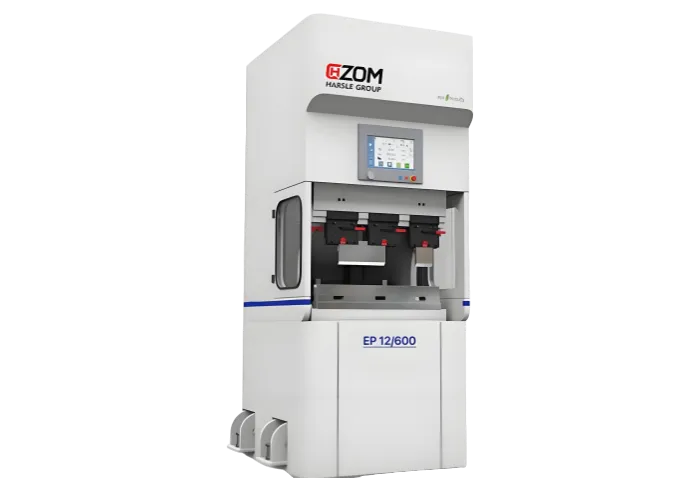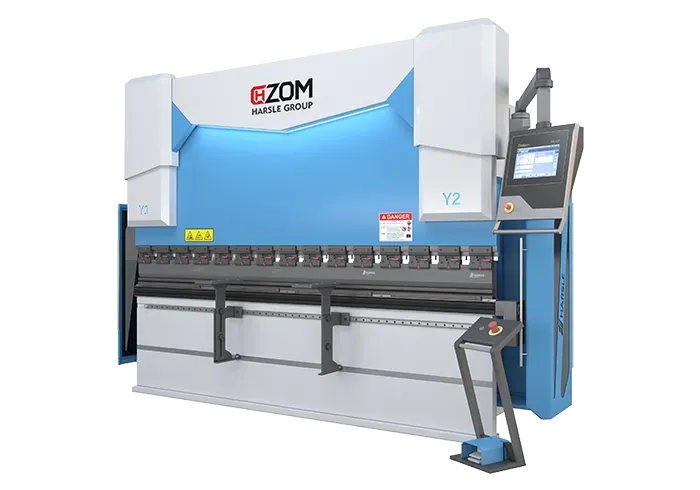
Workplace accidents such as finger crushing and unexpected slide drops happen frequently in press brake workshops. Global mainstream manufacturing safety standards now mandate laser safety guards as standard equipment for new bending machines. Traditional light curtains have obvious blind spots and failure risks, making intelligent laser protection the ideal upgrade solution. This blog compares mainstream laser sensing safety systems, helping press brake distributors and factory owners select matching safety accessories for different production scenarios.
Core Safety Hazards in Press Brake Operations
Before choosing protection devices, we need to identify the core risks threatening workshop operators:
- Finger pinching and crushing injuries are the most frequent accidents during manual feeding operations. Operators need to hold and position thin metal sheets close to the high-precision bending die repeatedly. Even minor operational misjudgments, distracted movements or unskilled feeding postures will instantly lead to severe crush or laceration injuries to fingers and palms.
- Uncontrolled slide falling caused by incomplete guarding brings fatal safety risks. Sudden mechanical failure, hydraulic system abnormality or non-standard manual misoperation may trigger an unexpected sudden drop of the equipment ram. When workers lean over or stretch their hands under the beam to adjust workpieces, calibrate positions or clean residues, this sudden movement will cause irreversible fatal injuries.
- Conventional light curtains have prominent inherent safety loopholes. Standard light curtains only create fixed linear detection zones with single coverage. They are easily blocked by common on-site obstacles such as customized jigs, supporting brackets, thick metal blanks and processing accessories, which directly leads to protection failure and leaves undetected safety hidden dangers.
These recurring accidents have pushed safety authorities across Europe, North America and Southeast Asia to tighten equipment safety regulations. All newly delivered press brakes must be fitted with reliable laser guarding systems.
Laser Guarding Systems: Types and Performance Comparison
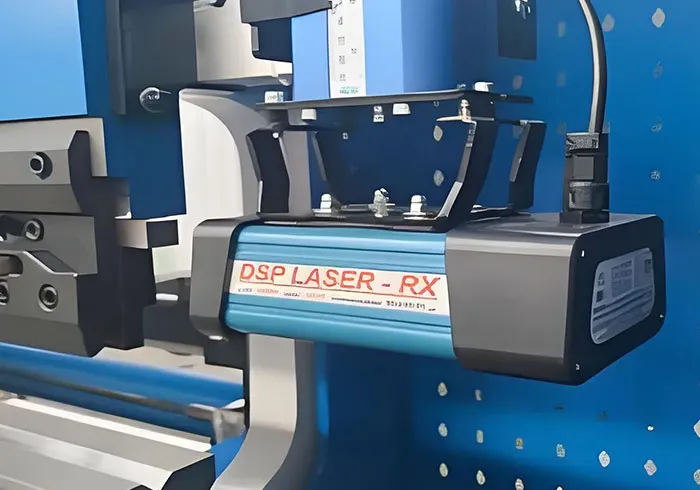
Laser guarding systems have emerged as a superior alternative to traditional light curtains, particularly for complex bending operations. These systems are mounted on the ram itself, projecting a beam just millimeters below the punch tip. If an obstruction breaks this beam, the machine stops instantly. Here are the main types available:
1. Single-line Laser Safety Light Barrier
This basic configuration projects a single continuous beam parallel to the bending line, typically positioned just below the punch tip. It offers an affordable entry point into laser safety, effectively detecting any object that intrudes into the immediate tooling area. While its coverage is limited to one plane, it provides essential protection for standard bending operations with simple part geometries and consistent feeding methods.
2. Multi-zone Dynamic Laser Protection
Designed for complex and high-value workpieces, this system projects multiple laser beams across different zones, creating a protective “halo” that adapts to varying tooling setups. It can differentiate between the part being bent and an operator’s hand, allowing for uninterrupted cycles on intricate profiles. This high-precision solution significantly reduces false triggers while ensuring comprehensive coverage around the entire punch and die area.
3. Auto Height Tracking Intelligent Laser Sensor
The most advanced option, this sensor actively tracks the ram’s position during the entire stroke. It continuously adjusts the protection field to maintain a constant, minimal safety distance from the tooling tip. This dynamic tracking maximizes operator access for complex parts while logging bending data and verifying stopping time performance, ensuring the system remains compliant and effective throughout the machine’s lifespan.
Choosing the Right Protection for Your Production Scenario
No universal laser protection fits all workshops, we provide targeted configuration suggestions based on common production layouts.
1. Short Flange Operations
For workshops that specialize in small brackets, electronic enclosures, or short-flange components, a single-line laser guard or a high-resolution safety light curtain is often the most practical solution. These systems offer reliable protection at a reasonable cost, and their quick response times allow operators to work confidently near the tooling without constant nuisance tripping. This configuration enhances both safety and productivity in high-turnover, repetitive bending tasks.
2. Multi-Axis High-Precision Press Brakes

When using advanced press brakes with automated tool clamping and high-speed backgauges, a dynamic multi-area laser guard is strongly recommended. These intelligent systems adapt their protective fields in real time, accounting for ram angle and tool geometry. They provide full coverage across all moving axes and integrate seamlessly with the machine’s CNC control, ensuring operators remain protected even during complex, multi-step bending sequences.
3. Tandem & Ultra-Long Press Brakes

For long-bed machines exceeding four meters, often used in tandem configurations, segmented laser systems are the ideal choice. They provide comprehensive coverage across the entire bending length and offer flexible zoning capabilities, allowing one section of the beam to be muted while others remain active. This ensures efficient processing of oversized panels without compromising worker safety at any point along the machine.
Conclusion
Buyers do not have to invest in the highest-grade laser safety sensors blindly. The most cost-effective safety setup is determined by your workpiece thickness, machine type and automation level. If you have confusion about selecting press brake safety accessories for hydraulic, pure electric or tandem press brakes, contact CHZOM for customized professional safety matching schemes tailored to your production line.